WEBSITES · FIELD NOTES
On October 2 I moved 1110ths.org, the site for Eleven Tenths, off WordPress. If you visit it today you won’t notice a thing. Underneath, it’s a very different page.
The site had been running on a WordPress plan with Elementor and a stack of plugins. When I looked at who actually used any of it, the answer was me. I’m the only person who edits the site, and the one custom plugin we’d set up for tracking contacts had been opened by exactly one person: also me.
WordPress is fine. What I couldn’t justify was paying for, updating and loading a whole content system that nobody needed.
What I actually moved
Nothing about the design changed, and that was the rule going in. I kept every page exactly as WordPress drew it and removed only the machinery behind it: the plugin scripts and the page-builder code. The contact form got rebuilt so it works without WordPress behind it.
Then I checked the new pages against the old ones at desktop, tablet and phone widths, element by element. 48 of the 51 checks matched exactly. The other three were the homepage’s spam-trap field, which is invisible to visitors on purpose.
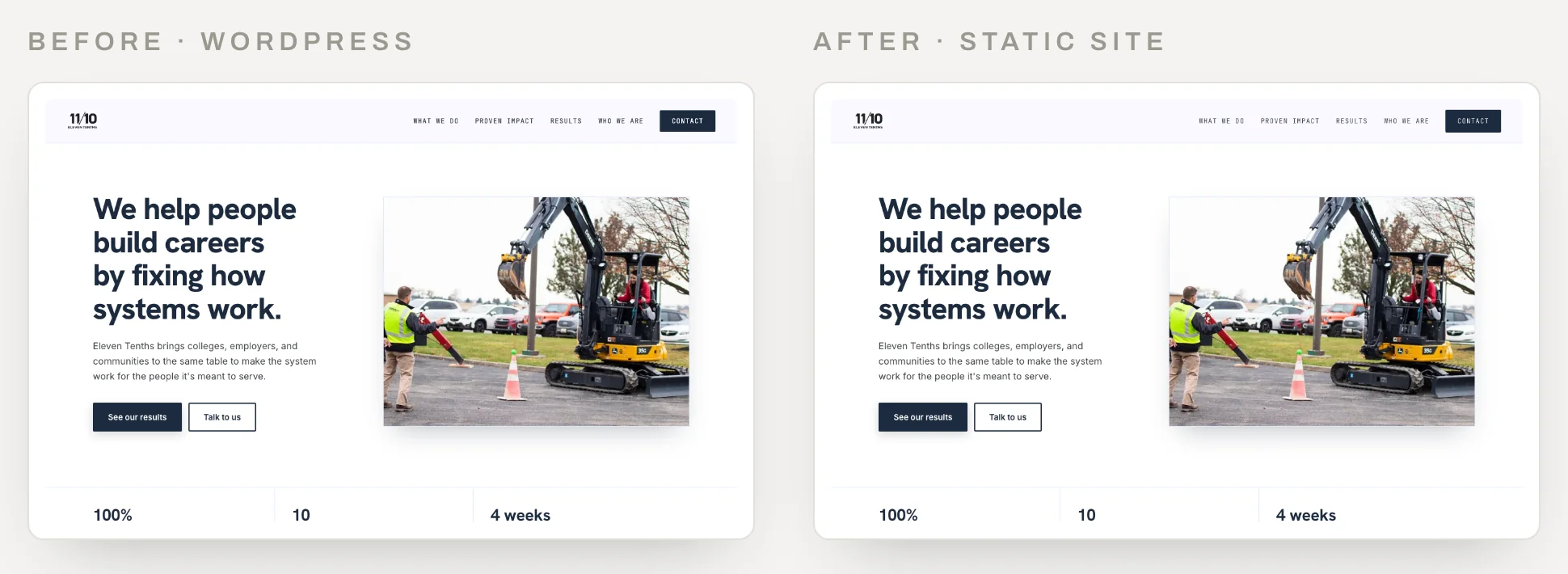
THE HOMEPAGE, BEFORE AND AFTER
Measured on the homepage before and after the switch, October 2, 2026.
The first score wasn’t the one I wanted
Lighter code doesn’t automatically mean a fast page, so I ran Google’s Lighthouse test on the new site. Mobile came back at 80. Fine, not great.
The report pointed at one thing: the big photo at the top of the homepage. It was still being delivered through WordPress’s image service, a separate server the browser had to find and connect to before it could show the most important picture on the page. On desktop, that photo was taking 2.2 seconds to appear.
So I made properly sized copies of every image and served them from the site itself. Same photos, same crops. I compared the headshots side by side to be sure.
LIGHTHOUSE, AFTER THE IMAGE FIX
Google Lighthouse 12 on the live site, middle score of six mobile and three desktop runs, October 4, 2026.
Where the load time goes now
This is the waterfall from one of those runs: every file the homepage asks for, in order, and how long each took. The page arrives first. Then the site’s own files come in a single wave, with the hero photo (in red) finished alongside the fonts and styles.
What’s left is small. The last two fonts load after the page is already readable, and one of them only exists for the contact form, which stays hidden until someone opens it. The other late arrival is Cloudflare’s visitor-stats script. On a test copy of the site without it, mobile scored 94, so that 10 KB is the cost of knowing how many people visit.
Should your site do this?
Not always. A static site is a great fit when the site changes a few times a month and one person makes the edits. If your team posts every week, or several people need to update pages without touching code, a content system like WordPress is still earning its keep.
What I’d look at first is how much of your current setup anyone actually uses. Most of the WordPress sites I open are carrying plugins nobody remembers installing.
If you want the speed side of this in more detail, I wrote about why a site can be fast on your laptop and slow on your customers’ phones.
If your site runs on WordPress and you’re not sure what half the plugins do anymore, I’m happy to take a look.